PROBLEMS OF ASPHALT AND CONVENTIONAL CONCRETE IN PORT TERMINALS: WHAT SOLUTION ENSURES LONG-TERM DURABILITY?
Port terminals and container yards are among the most aggressive service environments for pavement and slab structures. Selecting materials without rigorous engineering assessment of heavy-duty traffic and marine exposure conditions often leads to premature deterioration, escalating maintenance costs, and serious operational disruptions.
1. High-Stress Environmental Conditions at Port Terminals:
Before evaluating materials, it is essential to understand the primary deterioration mechanisms affecting port pavements:
- Extreme axle loads: Continuous 24/7 movement of prime movers, reach stackers, and RTG cranes generates intense, dynamic, and repetitive loading.
- Massive static loads: Stacked containers impose long-term compressive stress on pavement surfaces and substructures.
- Chloride attack (marine exposure): Chloride ions from seawater penetrate the material matrix, accelerating reinforcement corrosion and internal structural degradation.
- Thermal variation: Surface temperatures can reach up to 60–70°C under solar radiation. During asphalt paving, temperatures may approach 180°C. These thermal cycles induce significant expansion–contraction stresses.
2. Objective Assessment of Conventional Materials:
2.1 Asphalt Concrete: Rutting and Accelerated Ageing
Asphalt is often selected due to its lower initial investment and fast return-to-service capability. However, under port operating conditions, critical weaknesses emerge:
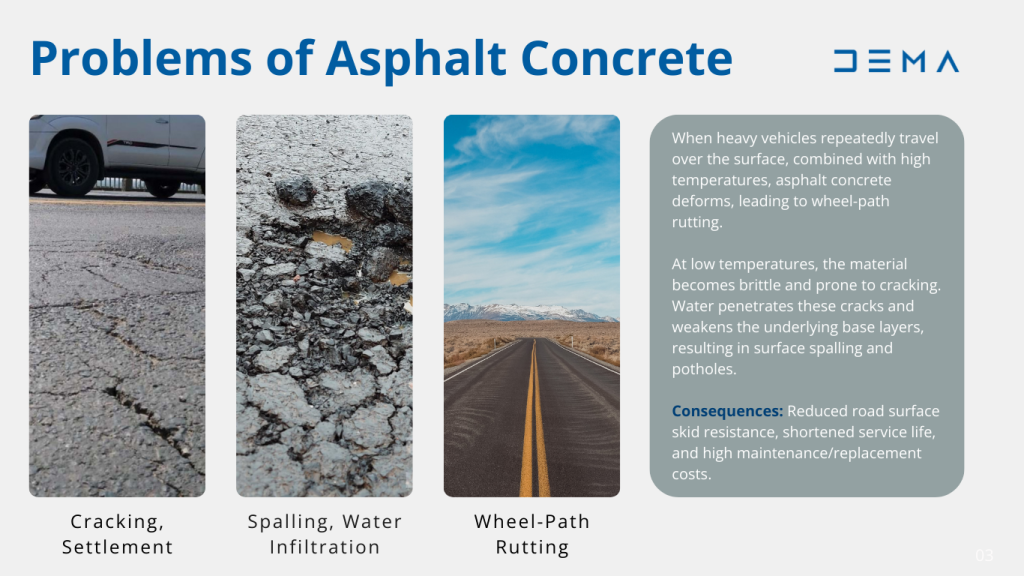
- Wheel-path rutting: At elevated temperatures, bitumen softens. Repetitive heavy wheel loads along fixed trajectories cause plastic deformation, forming deep ruts.
- Accelerated oxidation and ageing: UV radiation and salt exposure oxidise bitumen, reducing elasticity and leading to brittle cracking and surface ravelling.
- Water infiltration: Seawater penetrates through cracks, weakening the base layers and causing potholes and localised settlement.
2.2 Conventional Cement Concrete: Cracking and Corrosion Risks
Although cement concrete generally offers superior load-bearing capacity compared to asphalt, standard concrete without performance enhancement faces significant durability risks:
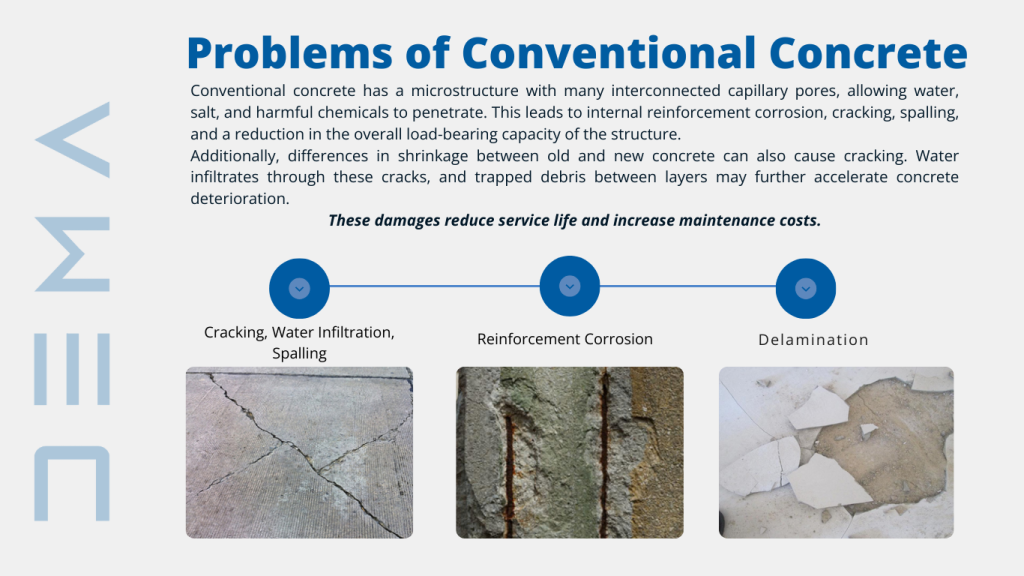
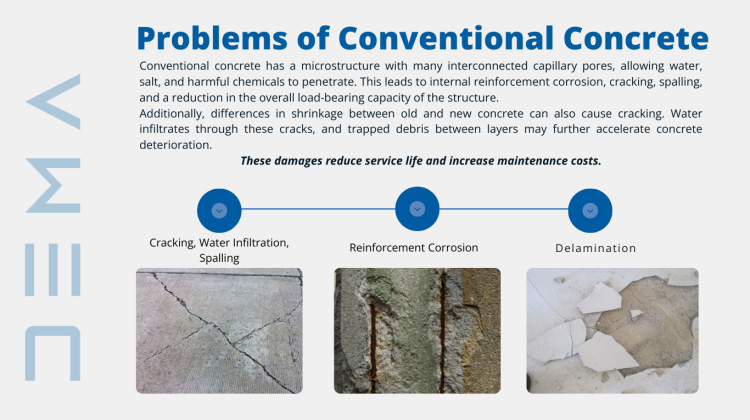
- Reinforcement corrosion: The capillary pore structure of conventional concrete allows chloride ingress. Corrosion products expand, generating internal tensile stress and surface cracking.
- Surface delamination and abrasion: Under repeated dynamic loads and high friction, insufficient surface hardness leads to abrasion, dusting, and large-scale surface spalling.
3. Engineering Trend: Surface Performance Enhancement Instead of Full Demolition
International best practice shows that for existing port structures, the preferred strategy is not:
- Full demolition
- Complete reconstruction
But rather:
- Surface strengthening
- Increasing structural density and impermeability
- Upgrading resistance to repetitive dynamic loading
- High-performance overlay systems provide:
- Reduced operational downtime
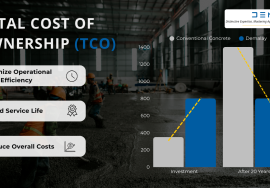
- Optimised life-cycle cost
- Protection of existing structural assets
4. DEMA’s Engineering Approach to Port Pavement Rehabilitation
From an engineering standpoint, a sustainable solution for port pavements must simultaneously achieve:
- Resistance to repetitive dynamic loads
- High microstructural density to limit permeability
- Chloride resistance
- Strong bonding with the existing substrate
- Long-term thermal and mechanical stability
The Demalay (latex-modified concrete) system developed by DEMA is engineered to:
- Increase microstructural density
- Enhance bond strength to existing concrete
- Improve abrasion resistance
- Reduce permeability
Rather than delivering a temporary surface treatment, the objective is to extend service life and mitigate long-term structural degradation risks.
5. Conclusion: Durability Is a System-Level Decision
In port terminals, the issue is not simply choosing between asphalt and conventional concrete.
The core challenge lies in:
- Understanding deterioration mechanisms
- Designing materials based on actual service environments
- Controlling construction quality and curing
- Evaluating life-cycle cost instead of initial cost
In modern logistics operations where continuous uptime is critical, investing in the right pavement engineering solution is not merely a technical decision — it is a strategic one.