Beyond MPa: The Real Reasons Why Industrial Floors Fail
Introduction
Across Vietnam’s rapidly expanding industrial parks, premature floor failure is becoming increasingly common, even in projects where high MPa concrete has been specified and properly cast.
The problem, in most cases, is not structural collapse but operational degradation
- Status: Floors remain standing, yet their performance steadily declines under real production and logistics demands.
- Consequences: Dusting surfaces, joint deterioration, surface delamination, and accelerated wear create continuous maintenance cycles that erode operational efficiency and increase lifecycle costs.
- Root Cause: The absence of surface engineering aligned with actual traffic intensity and environmental exposure.
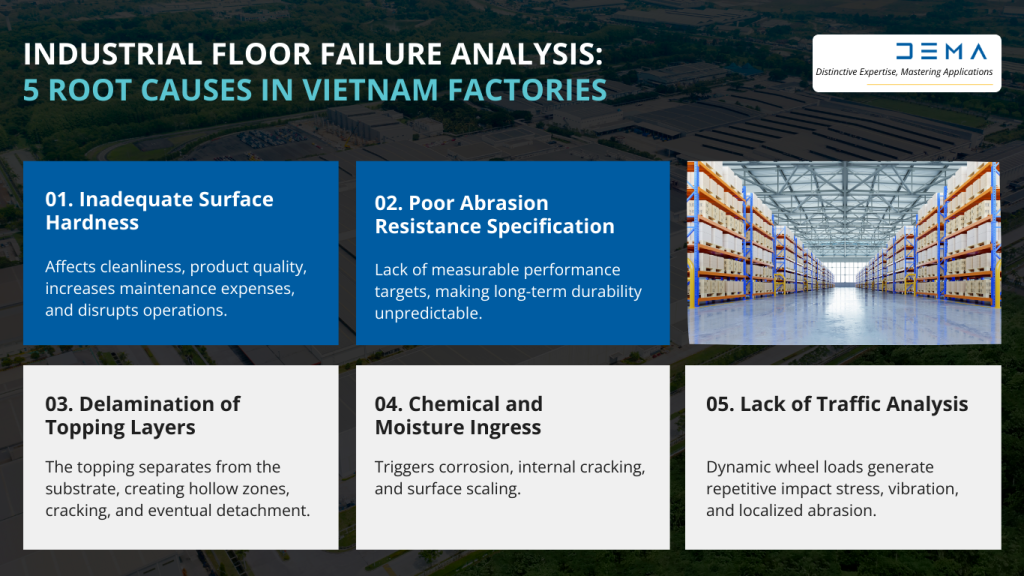
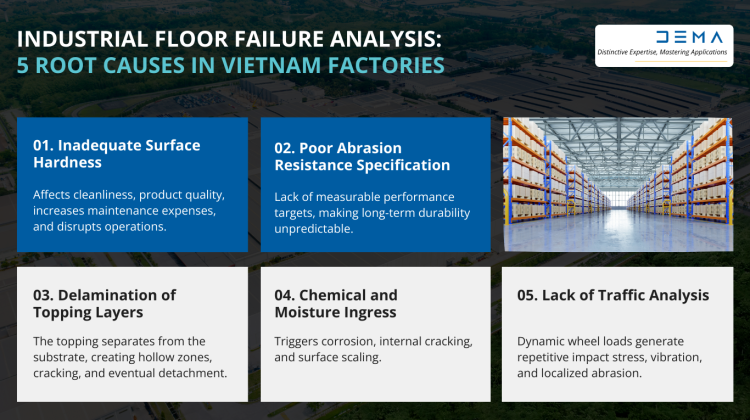
1. Inadequate Surface Hardness:
Standard concrete typically achieves a surface hardness of approximately 5–6 on the Mohs scale, which is often inadequate for factories operating high-frequency forklift traffic.
- Issue: Repetitive abrasion from hard wheels gradually breaks down the surface matrix, leading to dusting, micro-erosion, and progressive weakening of the surface.
- Impact: Affects cleanliness, product quality, increases maintenance expenses, and disrupts operations.
- Solution: Upgrading surface hardness to 6–9 Mohs through advanced densification systems such as Demahard®, extending the functional lifespan without structural reconstruction.
2. Poor Abrasion Resistance Specification
Many industrial projects focus heavily on compressive strength (MPa) while overlooking internationally recognized abrasion standards.
- Overlooked Standards: EN 13892-4, BS8204 – Part 2 standards, and TR34.
- Consequence: Lack of measurable performance targets, making long-term durability unpredictable.
- Result: Floors may technically meet structural criteria yet fail prematurely under dynamic mechanical stress.
3. Delamination of Topping Layers
This is a recurring issue, particularly in projects where surface upgrades are applied without sufficient substrate preparation.
Causes:
- Inadequate mechanical profiling.
- Contamination on the base slab.
- Improper bonding agents.
- Trapped moisture.
Consequence: The topping separates from the substrate, creating hollow zones, cracking, and eventual detachment.
Solution: Applying heavy-duty overlay systems such as Demalay® with strict surface preparation and moisture control protocols.
4. Chemical and Moisture Ingress
Industrial environments frequently expose slabs to oils, cleaning agents, mild acids, and continuous moisture cycles.
- Issue: Untreated or porous concrete surfaces allow these substances to penetrate the capillary structure, increasing permeability.
- Consequence: Triggers corrosion, internal cracking, and surface scaling.
- Solution: Surface densification treatments significantly reduce permeability, strengthening the microstructure and protecting internal reinforcement.
5. Lack of Traffic Analysis
This is one of the most overlooked factors during design and construction.
- Technical Difference: Static racking loads are fundamentally different from dynamic forklift impact.
- Issue: Dynamic wheel loads generate repetitive impact stress, vibration, and localized abrasion.
- Solution: Engineering must align material selection and surface treatment with actual traffic intensity, not theoretical assumptions.
Conclusion
Industrial floor durability cannot be defined by MPa alone. Long-term performance requires integrated surface engineering, traffic-based material selection, and lifecycle cost analysis.
DEMA JSC integrates in-house manufacturing capability with field-based engineering expertise to deliver performance-driven flooring solutions for:
🏭 FDI factories
📦 Ready-built warehouses (RBF)
🚢 Port infrastructure across Vietnam.
By addressing root causes rather than symptoms, industrial facilities can shift from reactive repair cycles to sustainable, long-term operational stability.